Basil Keck – Saturday, June 20, 2026
We were picked up by the President of the church youth at around 9:00 AM and taken to a pavilion on the east side of the runway.
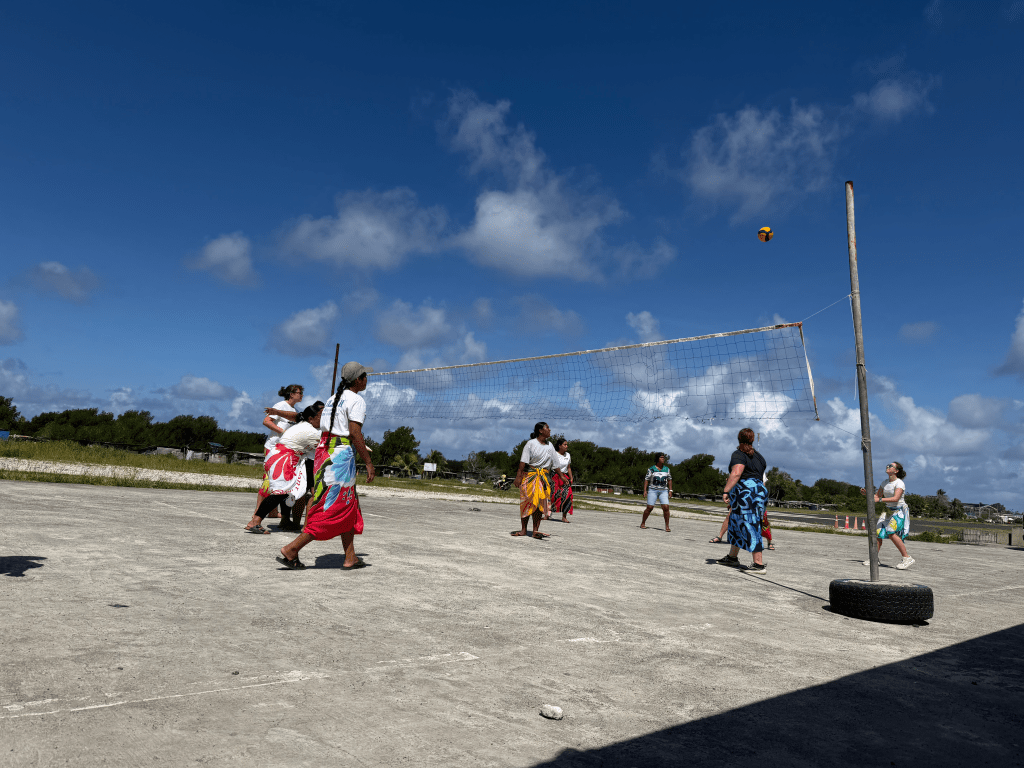
There we participated in some Tuvaluan ceremonies until we were taken outside to play volleyball with our respective church groups. It was a blast and a great way to become closer friends with our gracious hosts.
After that we had a little bit of a break where people just chilled out for a little bit inside. Eventually it was time for lunch where we ate a delicious prepared meal.
After lunch we separated into small groups to discuss with the locals their perspectives on climate change. My group consisted of myself, Naomi, Dr. Susan Clayton, and maybe eight Tuvaluans who took a little bit to warm up to us. One of the church leaders Ioane, who I had become close with, was willing to participate in the conversation from the get-go. He loosened up the others and as we talked the group slowly warmed up; by the end of the allotted time we were able to have a really wonderful conversation.
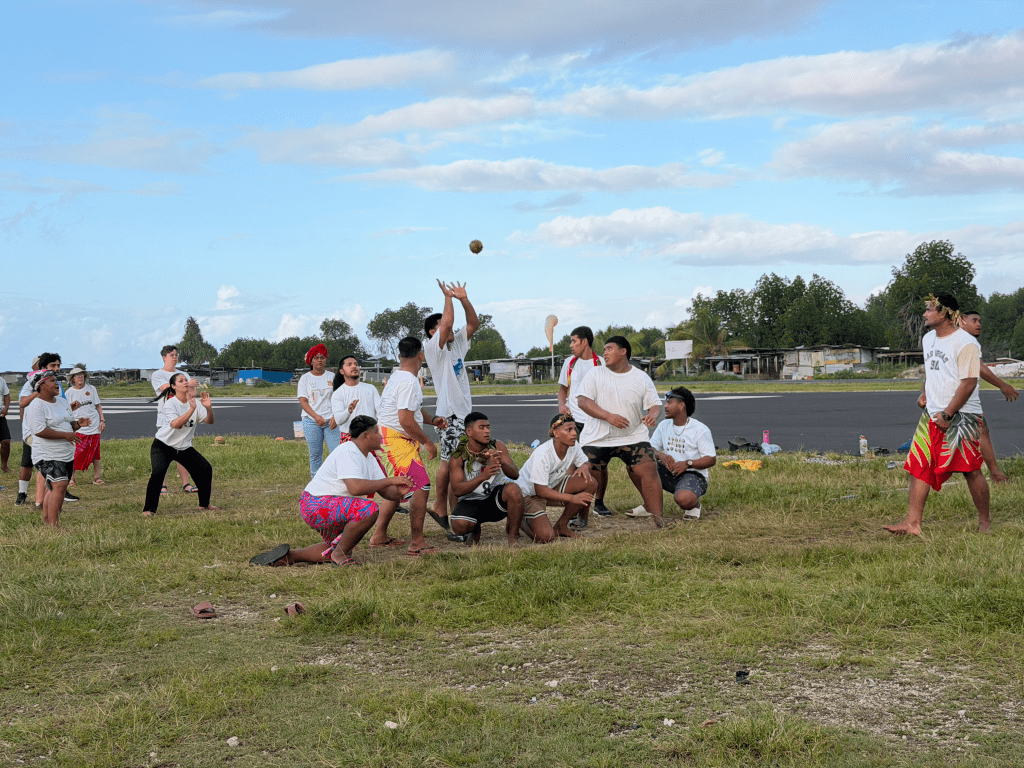
After the conversation we got to enjoy a super fun Tuvaluan game that involved throwing and passing a roughly softball-sized ball made of leaves. It was incredibly fun to learn and play but certainly not for the weak. I was retying my sarong and almost got decapitated. I was not very good at that game.
Our time in Tuvalu has been incredibly enlightening, but I personally found this discussion to be the most powerful experience of this entire trip. We had interacted with the Funafuti citizens extensively, but only ever in a tour-ish situation. During this discussion, we were able to engage with people who lived at the forefront of the climate crisis in a new way and have a chance to truly understand their perspectives on it.
The Tuvaluans were sharing their ideas of what the future of Tuvalu was, and their thoughts about the number of people moving away to Australia and New Zealand. They were telling us about how each family has their reasons for leaving, whether it be for work or school or just generally better futures for their children. When discussing the future of Tuvalu though, the youth would make jokes about Tuvalu sinking. Naomi and I were incredibly struck by this, how could they laugh so freely about the loss of their home?
One man explained to us that although they laugh about it on the inside, they were all deeply concerned for their home. They said something to the effect of: “this is the ‘happy island’, we wear smiles on our faces even when things are hard”.
This entire trip has been a lesson to me about hope and determination in the face of climate change, but here in this discussion something clicked for me and my mindset is forever changed. The thing that did this for me was a comment from a young man who didn’t seem much older than me.
He said something along the following: “We know Tuvalu will be underwater within our lifetimes, but we will not stop fighting”.
This sentiment seems to be shared by many here; people are completely hopeless, but at the same time, completely determined.
Even writing this now, I’m tearing up. Imagine that feeling. Imagine knowing that your home and the history of your entire people will be completely gone, and there is nothing you can do about it.
In the United States we don’t always share this deep of a connection to our land. Many do, but many move from place to place several times within their life, and their connections are simply to other things.
But maybe you do have such a connection to your home, you were raised in a specific place, and your parents were raised there, and maybe their parents and perhaps their parents before them. Maybe your entire family, all your cousins and aunts and uncles were raised there too. Maybe all your friends and their families as well.
Now imagine that place, all the buildings and parks and rocks and playgrounds and libraries and graveyards, your history, are all washed away. Imagine your family and friends scattered to the winds. Your culture and traditions are broken into pieces. You can’t raise your kids there, and future generations will only know stories of your home. They will never be able to see their history.
Imagine it’s not your fault; you did nothing to cause it and you could do nothing to stop it. Is the perpetrator’s comfort worth your history? What would you want them to do?
Now: what will you do?
 Pacific Climate Justice TREK
Leave a comment