The day started off with a talk from Wilfur about the Center for Sustainable Futures (CSF) at the University of the South Pacific (USP) lower campus, where we attended the beach cleanup on World Ocean Day. CSF provides degrees from bachelor’s to PhD’s in topics such as marine science, marine management, and island and ocean stewardship.
After the overview, we received a tour, starting off with viewing the food testing unit with Jeremy. Before being allowed on shelves, food imports are ensured to meet international standards of hygiene and contaminants through extensive chemical testing here. It was interesting to hear the behind the scenes view of the food system! The lab also conducts water testing for sea contaminants and drinking water, and is experimenting with biofuels and exploring the possibility and impacts of deep sea mining.
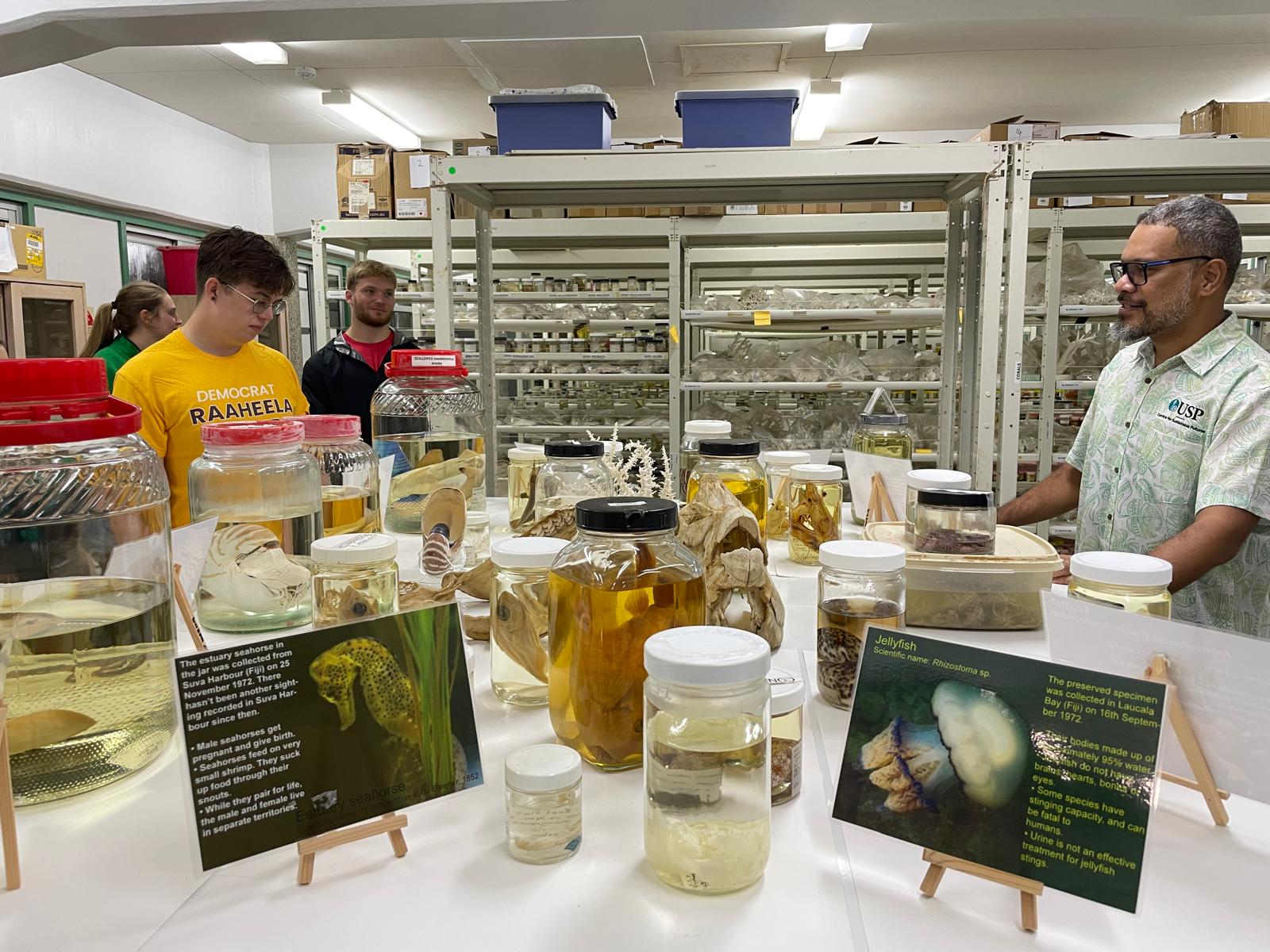
We then received a tour of the specimens collection from Kelly Brown, who will complete his PhD from USP in a few days. We saw hammerhead sharks, octupuses, turtle eggs, and other specimens suspended in jars of ethanol, while Kelly described the discoveries that have been made recently about marine speciation in the Pacific, and how our understanding of ocean currents can be used to better inform where marine protected areas would most benefit the ecosystem. He also discussed the intricate balance that is needed when engaging with communities, because while it is important to educate communities about conservation, it is also important to listen and incorporate the traditional knowledge that already exists within communities.
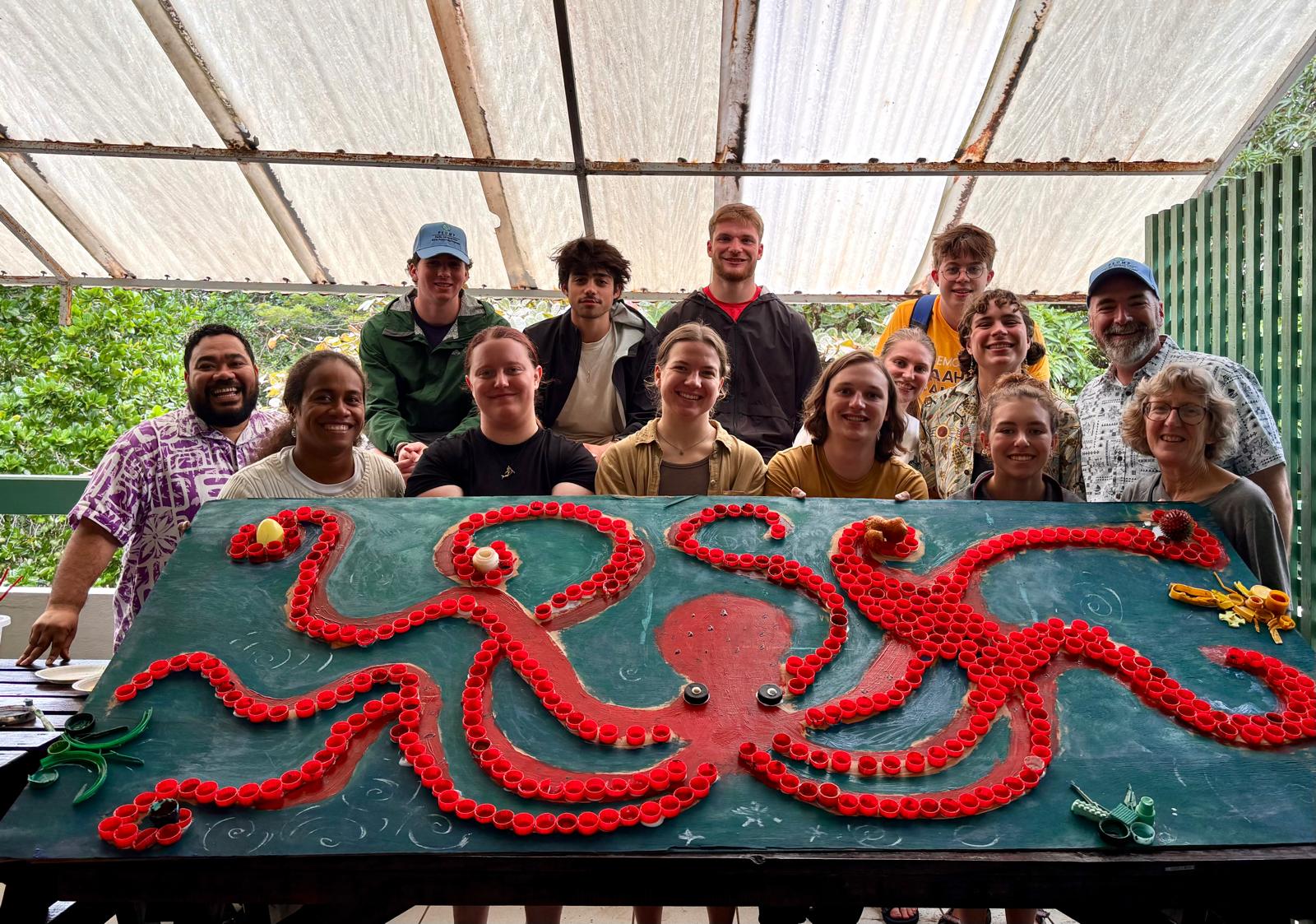
To finish our morning at USP, we worked with Susan, CSF’s graphic designer and a leader of the Pacific Ocean Litter Youth Project (POLYP), which works with youth to create art out of marine debris as ocean advocacy, a strategy called “art-ivism”. We learned about waste management strategies in Fiji, then had the opportunity to create some art-ivism of our own. Inspired by the famous octopus map of the Pacific, which portrays the ocean as a unifying force rather than a divider, we chose to create an octopus surrounded by seaweed and coral. In less than 30 minutes we had created our ocean scene from beach trash.
In the afternoon, we heard a talk from Francis about ecological stewardship work that the Pacific Conference of Churches (PCC) is doing. She described how, since the PCC’s origins in 1961, they have unified churches in facilitating the varying asks of communities. Starting in 2004 and becoming more prevalent since, has been climate justice work.
Cyclones have always been a part of Pacific life, but they are now occuring 2-3 times per year, much more frequently than ever before, and communities are constantly in a state of recovery and preparation. Some small islands have tidal waves that cover the entire island. Communities need help, but they differ in the amount of relocation versus adaptation support needed.
The PCC helps these communities by abiding by the “3 P’s”. The first P is “prophetic”, and refers to the advocacy work PCC does in national and international spaces to bring morality to politics and policy. The second P, “pastoral”, refers to how PCC accompanies churches and church leaders as they develop and implement ecological stewardship programs and projects in their own communities, as well as identifying ways the communities can become self-sufficient without continual PCC support. Finally, the third P is “practical” which incorporates the need to quantify and demonstrate their impact on communities in order to receive funding such as grants.
Since PCC has coordinated many of our other experiences and works with those organizations and communities, we were able to learn more about them from PCC’s perspective. We spoke about the Togoru village, where we visited Barney earlier this week, and the difficulty of helping a community that the government seems to want to abandon due to their perceived non-indigenaity and the cost of building a sea wall to effectively protect the land. We also learned that the PCC “walks the walk” of working for a sustainable future by taking the Uto Ni Yalo, the traditional Drua sailboat we heard about earlier this week, when traveling to other islands for conservation work to demonstrate that carbon-independent transportation is viable.
Overall, our experiences today demonstrated the wide variety of ways to work for conservation and climate justice. The Center for Sustainable Futures demonstrates the learning, education, and applied science of protecting the environment and allowing humans access to safe food and water, while Francis’s talk demonstrated the variety of efforts that are needed to help communities in a changing climate.
 Pacific Climate Justice TREK
Leave a comment